Spoiler: it's not the same answer for a tent, a theater curtain, and a refinery coverall.
You know how an iron has different settings? Cotton. Linen. Polyester. Silk. You don't set it to Cotton and press a polyester shirt. Unless you enjoy scraping melted fabric off the soleplate and explaining yourself to someone.
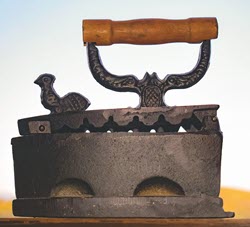
We mention this because buyers ask us for "the best FR finish" like there's one universal answer. There isn't. Just like your iron, different applications need different settings. A tent that sleeps eight people in bear country needs a different FR treatment than a theater curtain in a downtown auditorium.
A coverall worn by someone working in a refinery requires a different approach than a tablecloth battling red wine at an event.
FR doesn't mean fireproof. Nothing is fireproof. Proof? Half a million acres was chewed up by wild fires in 2025 in California. FR means flame retardant — the fabric resists ignition, self-extinguishes, or slows the spread of flame. Different standards test for different things. Some want the fabric to stop burning when the flame source is removed. Some want it to not drip. Some want the fabric to char.
The spec you need depends on the application — and on understanding how different fibers burn. Cotton. Polyester. Wool. Rayon. They don't all behave the same way in a fire. A tent requires different testing than a theater curtain. A military cover is different from a hospitality tablecloth. Know your spec before you shop the finish.
Then there's the chemistry. Because "FR" isn't one thing. It's a family of chemistries, each working differently:
If this list makes your head spin, you're not alone. There are volumes written on this stuff (the Non-Halogenated Flame Retardant Handbook by Morgan & Wilkie is a good place to start, if you're having trouble sleeping). The point isn't to memorize the periodic table. It's to understand that "FR" is a category, not a product. The right one depends on your fiber, your application, and your spec.
Built on 1920s Canvak formula. Smells like it. That's how you know it's working.
Also in Mil-Spec shades. See Mil-Spec Fabrics →
You send the spec number. We confirm the chemistry. We run a trial.
| Application | Recommended Finish | Standard |
|---|---|---|
| Canvas tent / tipi / yurt | Pyrosnuff | CPAI-84 |
| Glamping tent / wall tent | FWR | CPAI-84 |
| Boat cover / mooring cover | FWR | CPAI-84 |
| Theater curtain / drapery | Bulk FR | NFPA-701 |
| Upholstery / furniture | Bulk FR | California-117, BS 5852 |
| Automotive interior | Bulk FR | MVSS 302 |
| Industrial PPE / FR clothing | Bulk FR | NFPA 2112, ASTM D6413 |
| Children's sleepwear | Bulk FR | 16 CFR Part 1615 |
| General clothing textiles | Bulk FR | 16 CFR Part 1610 |
| Military / government contract | Call us with the spec number | — |
A quick word on standards. Different industries and regions rely on strict testing to evaluate burn time, char length, and flame propagation. Here are the ones that come up most often:
🔥 FR finishes don't last forever.
Even durable FR finishes degrade with repeated washing. Most FR-treated cotton duck is meant for applications where the fabric stays in place — tents, covers, fixed installations. If your product needs to be laundered regularly, tell us upfront. We'll talk about whether FR cotton is the right call or if you need a different approach.
FR chemistry adds cost. Any finish does. But FR is one of the more expensive treatments because the testing is rigorous and the chemistry isn't cheap. Budget accordingly. We'll quote honestly.
Some FR chemistry isn't compatible with certain dyes. If you need a specific color AND an FR finish, we need to test compatibility. Don't assume it works. We don't. In principle, we will NEVER play with a fire.